
Last updated: 2 November 2026. Rupee figures use €1 = ₹106 and £1 = ₹127 (ECB reference rates, 30 October 2026) and are rounded.
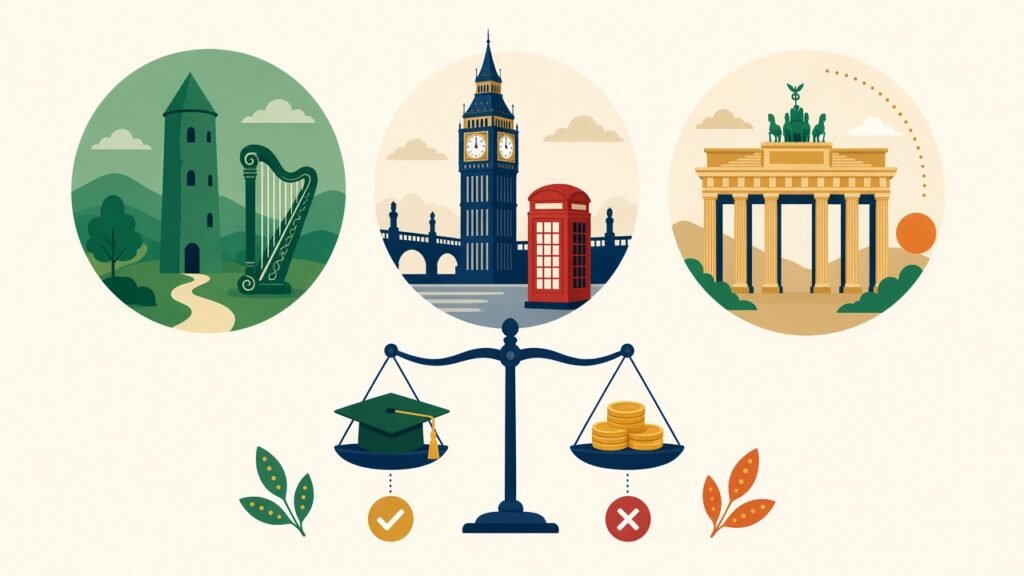
Ireland vs UK vs Germany is the shortlist most Indian master’s applicants end up with for 2027.
All three teach in English, welcome Indian students and let you stay on to look for work.
But the bills, the course length and the road to settling are very different.
A cheap course can still cost you two years of income, and a fast course can come with a short visa.
In this guide, you’ll learn what each country costs in rupees, the money you must show, visa and health fees, work rules, post-study visas, the path to permanent residence and which country suits which student.
Every rule below comes from a government or official source, checked for 2026.
In a Hurry? Read This Quick TL;DR Summary
- Cheapest: Germany, where most public universities charge no tuition; Baden-Württemberg charges non-EU students €1,500 per semester.
- Fastest: the UK and Ireland, where most taught master’s last one year; Germany’s last two to four semesters.
- Money to show: UK up to £13,761 for London living costs, Germany €11,904 in a blocked account, Ireland €10,000 plus fees.
- Post-study visa: UK Graduate visa drops to 18 months for applications from 1 January 2027; Germany gives up to 18 months; Ireland’s Stamp 1G gives 12 months, plus 12 more for eligible graduates.
- Settling: Germany’s route is the quickest on paper for its own graduates, but it needs German.
- UK settlement: a move from 5 to 10 years has been proposed but was not final when we checked.
Still planning your move? Start with our complete guide to studying in Ireland from India.
Ireland vs UK vs Germany: The Quick Comparison
Here’s how the three countries line up on the factors that matter most to Indian students.
Each row is explained, with sources, in the sections below.
| Factor | Ireland | UK | Germany |
|---|---|---|---|
| Typical master’s length | 1 year | 1 year | 2–4 semesters (often 2 years) |
| Tuition, non-EU | €13,500–€29,500 | £9,000–£30,000 | Mostly none at public universities |
| Money to show for living costs | €10,000 plus fees | £1,171–£1,529 a month, up to 9 months | €11,904 in a blocked account |
| Work during term | 20 hours a week | 20 hours a week | 140 full or 280 half days a year |
| Post-study visa | 12 + 12 months (Stamp 1G) | 18 months (from 2027) | Up to 18 months |
| Language for daily life | English | English | German, in practice |
How Much Is Tuition in Each Country?
Tuition is where the three countries differ the most.
1. Ireland
Non-EU master’s fees for 2026/27 run from about €13,500 to €29,500 (₹14.3–31.3 lakh) at the main universities.
Rent is the swing factor, so compare Dublin with Cork.
Business, data and engineering courses usually sit in the upper half of that range.
2. The UK
The British Council puts international postgraduate fees at £9,000 to £30,000 (₹11.4–38.1 lakh) a year (Study UK).
For example, SOAS lists overseas taught master’s fees of £26,330 and £27,755 for 2027/28 (SOAS fees).
That’s about ₹33.4–35.2 lakh for one year, and London fees are often at the top of the range.
3. Germany
DAAD says there are generally no fees for bachelor’s courses or most master’s courses at state universities (DAAD, costs).
Baden-Württemberg charges non-EU students €1,500 per semester (₹1.59 lakh), or about ₹6.4 lakh over four semesters (Baden-Württemberg ministry).
Bavarian universities may also charge non-EU students, and DAAD says this can reach several thousand euros per semester.
Every student also pays a semester contribution of €70 to €430 (₹7,400–45,600), which often includes a transport ticket.
Private German universities charge much more, so check whether a course is at a state university.
What Will You Spend in Total?
Course length changes the maths, because Germany usually means two years of rent instead of one.
The figures below are our illustrations, built from the official ranges above. They exclude flights and health insurance where noted.
| Country and city | What’s included | Approximate total (INR) |
|---|---|---|
| Ireland, Dublin | 1 year: fees plus living costs | ₹49–62 lakh |
| Ireland, Cork, Galway or Limerick | 1 year: fees plus living costs | ₹37–53 lakh |
| UK, outside London | 1 year: fees, £900–£1,300 a month living, visa and IHS | ₹27–60 lakh |
| UK, London | 1 year: fees, £1,300–£1,400 a month living, visa and IHS | ₹33–62 lakh |
| Germany, most states | 2 years: €900–€1,200 a month living, 4 semester contributions, visa | ₹23–32 lakh |
| Germany, Baden-Württemberg | As above, plus €6,000 tuition | ₹30–39 lakh |
The UK living ranges are British Council estimates, and Germany’s €900–€1,200 a month is DAAD’s estimate.
The Ireland figures come from our cost of studying in Ireland guide.
Germany’s figures leave out health insurance, which you must arrange separately, so add it to your budget.
How Much Money Must You Show for the Visa?
Each country asks for proof that you can pay your living costs, but the rules differ.
| Country | Requirement | INR (approx.) |
|---|---|---|
| Ireland | €10,000 for living costs, plus your fees | ₹10.6 lakh plus fees |
| UK, London | £1,529 a month for up to 9 months (£13,761), plus unpaid fees | ₹17.5 lakh plus fees |
| UK, outside London | £1,171 a month for up to 9 months (£10,539), plus unpaid fees | ₹13.4 lakh plus fees |
| Germany | €11,904 in a blocked account, with €992 a month released | ₹12.6 lakh |
The UK amounts are on GOV.UK.
The German blocked-account amount is on the German missions in India study visa page.
For Ireland, our proof of funds guide explains the €10,000 rule and what statements work.
What Do Visas and Health Charges Cost?
The UK is the most expensive here, because of the Immigration Health Surcharge (IHS).
| Fee | Ireland | UK | Germany |
|---|---|---|---|
| Student visa | €60 single entry, charged as ₹5,300 in India, plus VFS fees | £558 (₹71,000) | €75 (₹8,000) |
| Health charge | Private insurance required; student plans from about €177 (₹18,800) a year | IHS £776 a year (₹98,600) | Health insurance required |
| Registration on arrival | IRP €300 (₹31,800) | None | Local residence permit fee |
The UK visa fee is on GOV.UK, and the IHS rates are on the IHS page.
For a visa of 18 months or less, the IHS is the yearly rate plus half, so £1,164 (₹1.48 lakh).
A one-year course usually gets a visa of over 12 months, so expect this figure. Use the GOV.UK calculator for your exact dates.
Germany’s €75 national visa fee is on the German missions’ visa fees page.
Ireland’s fees are on the ISD visa fees page, and our Ireland student visa guide covers each step.
Can You Work Part-Time While You Study?
All three let you work, but Germany counts days rather than hours.
- Ireland: 20 hours a week in term and 40 hours a week in the official holidays (Citizens Information).
- UK: degree-level students can work 20 hours a week in term and full-time outside term (Appendix Student).
- Germany: up to 140 full days or 280 half days a year; jobs as a student assistant at your university don’t count (§16b Residence Act).
In Germany, a week of up to 20 hours during the lecture period can also be counted as 2.5 days.
Part-time pay helps with groceries and rent, but it won’t cover tuition in any of the three.
Which Country Gives the Best Post-Study Work Visa?
This is where 2027 brings a real change in the UK.
| Country | Visa | Length |
|---|---|---|
| Ireland | Stamp 1G (Third Level Graduate Programme) | 12 months for a master’s, plus 12 more if eligible |
| UK | Graduate visa | 2 years if you apply by 31 December 2026; 18 months from 1 January 2027 |
| Germany | Job-seeker residence permit | Up to 18 months after graduating |
If you start a one-year UK master’s in 2027, you’ll graduate in 2028 and get the 18-month Graduate visa (GOV.UK).
The Graduate visa costs £937 (₹1.19 lakh), plus IHS of usually £1,035 (₹1.31 lakh) a year, and you can’t extend it.
Germany’s 18-month permit is in §20 of the Residence Act.
Ireland’s rules are on the ISD graduate programme page, and our Stamp 1G guide explains how to apply.
How Long Until Permanent Residence?
None of these countries counts your study visa straight into PR, but the timelines after you get a job differ a lot.
1. Ireland
A Critical Skills Employment Permit can lead to Stamp 4 after 21 months on the permit (ISD), against 57 months on a General Employment Permit. Our guide to Irish immigration stamps explains each step.
For citizenship, you need 5 years of reckonable residence in the last 9, and Stamp 2 student time doesn’t count (ISD citizenship guide).
2. The UK
The government says Skilled Worker migrants can typically settle after 5 years today.
Its earned-settlement consultation proposes raising the baseline to 10 years, with shorter routes for some (GOV.UK consultation).
When we checked, the final rules for these timelines were unclear, so treat the UK timeline as uncertain.
Settlement applicants also need a higher, B2-level English standard from March 2027 (GOV.UK).
3. Germany
German graduates in skilled jobs can get a settlement permit after 2 years of work and pension contributions, with sufficient German (§18c Residence Act).
EU Blue Card holders can qualify after 27 months, or 21 months with sufficient German.
Citizenship is possible after 5 years of lawful residence (§10 Nationality Act).
Do You Need to Learn German?
Many German master’s programmes are taught fully in English, so you can study without German.
Daily life is another matter, from landlords and offices to many part-time and graduate jobs.
Germany’s faster settlement routes also require German, as the law above shows.
If you won’t commit to learning German to at least B1, Ireland and the UK are the safer picks.
How Many Indian Students Choose Each Country?
India is now a top source country for all three, though each counts students differently.
- UK: 82,523 study visas were granted to Indian main applicants in the year to June 2026, down 16% (Home Office).
- Germany: around 69,000 Indian students were enrolled in winter semester 2025/26, the largest group (DAAD).
- Ireland: 9,175 Indian nationals were enrolled in publicly funded higher education, per the latest HEA data cited in the Dáil (Oireachtas).
The UK figure counts visas granted in a year, while the other two count enrolled students, so don’t compare them directly.
Should You Choose Ireland, the UK or Germany?
Use this Ireland vs UK vs Germany decision table to match each country to your situation.
| Choose… | If you… |
|---|---|
| Ireland | Want a one-year English-speaking course, up to two years of Stamp 1G and a clear route to Stamp 4 in tech, data, pharma or engineering. |
| UK | Want the widest choice of universities and courses, a one-year degree and can accept an 18-month Graduate visa and unsettled settlement rules. |
| Germany | Want the lowest tuition, can spend two years studying, and are ready to learn German for jobs and settlement. |
If Ireland fits, compare the best universities in Ireland for Indian students.
Then read whether a master’s in Ireland is worth it for your field and budget.
The Bottom Line: Ireland vs UK vs Germany — Which Should You Pick?
Germany is the cheapest option on paper, but it takes two years and real effort in German.
The UK has the biggest choice, but its Graduate visa shrinks to 18 months from 2027.
Ireland sits in between, with a one-year course, English-speaking jobs and up to two years to job-hunt.
Which matters more to you: the lowest bill, or the fastest start to your career?
Answer that honestly, and your choice usually becomes clear.
Ready for the next step? Go back to our complete guide to studying in Ireland from India.
Disclaimer: IrelandStudyGuide.com is an independent guide. This article is general information, not legal, financial or immigration advice. We have no relationship with UK Visas and Immigration, the Home Office, the British Council, SOAS, the German Federal Foreign Office or German missions in India, DAAD, the Baden-Württemberg Ministry of Science, Immigration Service Delivery, Citizens Information, the HEA, the Houses of the Oireachtas, the ECB, or any university named. Fees and immigration rules change, so always check the official source before you apply.